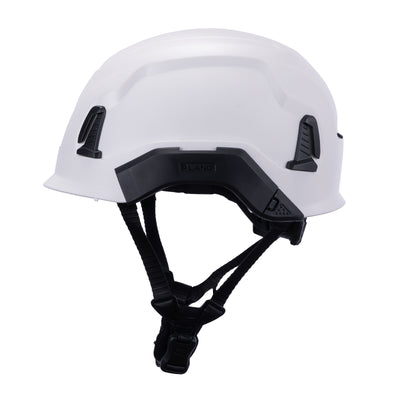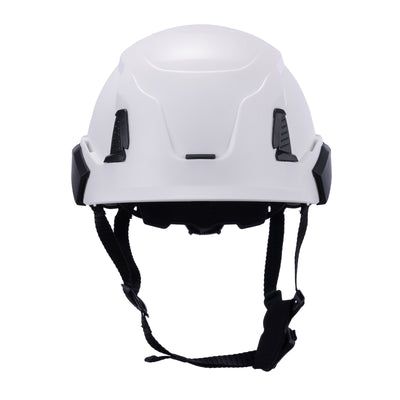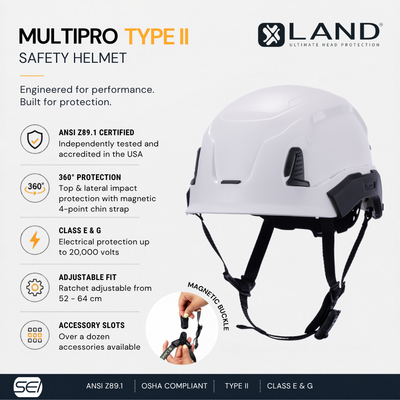


What Happens When a Safety Helmet Is Designed Around the Worker?
When we started thinking about what would eventually become the LAND MultiPro, we weren't trying to make another helmet just to add another product to the market.
We kept coming back to a much simpler question:
What do the people wearing these helmets every day actually need?
It sounds obvious. A safety helmet is made to protect your head.
But a worker doesn't experience a helmet as just a shell.
They experience it while working in the sun. Around loud equipment. While moving between tasks. While wearing eye and face protection. While carrying tools and trying to get through a full shift without their PPE becoming another thing they have to fight with.
So we started listening.
We spoke with people working in construction, utilities, tree care, and other trades, and different jobs brought different problems.
An arborist might need face and hearing protection. A utility worker may need electrical protection. Someone in construction might want a brim in the morning, a visor later, and somewhere to keep something as simple as a pen.
The jobs were different, but the conversations kept pointing us toward the same idea:
The helmet should adapt to the worker. The worker shouldn't have to adapt to the helmet.
That became the foundation of the MultiPro.
Because the Job at 8 AM Isn't Always the Job at 2 PM
A workday rarely stays the same from beginning to end.
Tasks change. Weather changes. Light changes. Equipment changes.
That can be especially noticeable outdoors, where the working environment can change considerably over the course of a single shift.
So why should a helmet be locked into one configuration?
We wanted MultiPro to give workers a lightweight, adaptable platform that could be configured around the work being done without becoming overly complicated.
Its Type II Class E protection provides the foundation. From there, the rest of the helmet is about adapting that protection to the person, task, and environment.
Because meeting a safety standard matters.
But so does creating PPE that people can actually work with.

Clear, Smoke or Mirror? It Depends on the Day.
Face protection was one of the clearest examples of why flexibility matters.
One worker may be indoors. Another may be outside in bright conditions. The same person might experience both during the same project.
That's why MultiPro was designed around multiple visor options:
Clear for conditions where maintaining natural visibility is important.
Smoke for brighter outdoor environments.
Mirror for another option when dealing with bright light and glare.
The point isn't that one visor is the answer.
The point is having options.
Instead of forcing every worker into the same configuration, the visor can be selected based on the conditions in front of them.
Why Should a Brim Be All or Nothing?
We approached the brim with the same thinking.
Instead of permanently building a full brim into the helmet, MultiPro uses separate front and rear brim sections.
That opens up more ways to configure the helmet.
Need the brim? Add it.
Don't need it? Remove it.
Need to use other compatible components? Configure the helmet around the work you're actually doing.
But there was another detail that mattered to us:
Adding one accessory shouldn't make another accessory useless.
That's why the brim system was developed with hearing protection in mind, allowing compatible earmuffs to remain part of the setup.
It sounds like a small consideration.
In practice, those are exactly the kinds of details that determine whether a modular system is actually useful.

Hearing Protection Should Feel Like It Belongs There
For arborists and workers around saws, chippers, machinery, and other loud equipment, hearing protection may be part of the everyday setup.
We didn't want earmuffs to feel like something awkwardly added to the helmet afterward.
They needed to feel like part of the system from the beginning.
That principle became a simple rule for the MultiPro:
Add what you need. Remove what you don't.
That's what we mean when we talk about modularity.
Not more pieces for the sake of having more pieces.
More control over how the helmet is configured.
Then Someone Asks, “Where Do I Put My Pen?”
Not every useful piece of feedback is about impact protection or electrical ratings.
Sometimes it's much simpler.
Where do I put my pen?
How do I know which helmet is mine?
Those questions helped influence details such as the pen holder and name tag options.
They're probably not going to be the first features someone notices in a product photo.
But that's also the point.
People who wear PPE every day notice the small inconveniences.
A helmet designed around real workers should pay attention to them too.

One Helmet. Different Crews. Different Colors.
Adaptability isn't limited to accessories.
For companies outfitting larger teams, helmet color can become part of how a crew is organized or presented.
Different colors may be used to distinguish departments, responsibilities, crews, supervisors, or visitors. Other companies may simply want their PPE to coordinate with an existing company color or safety program.
That's why we wanted MultiPro colors that could work across different industries and company environments.
Construction shouldn't feel like an afterthought.
Neither should utilities.
Neither should tree care.
The MultiPro wasn't designed around one type of worker.
It was designed to fit into the systems different workers and companies already use.
The Best Product Meetings Didn't Always Happen in a Meeting Room
A lot of the MultiPro story comes back to one thing:
Listening.
The people wearing safety equipment for eight hours at a time notice things that are difficult to understand from behind a desk.
They know when two accessories constantly interfere with each other.
They know which feature is frustrating while wearing gloves.
They know what feels fine for ten minutes but becomes annoying after several hours.
And they definitely know which piece of equipment keeps getting left in the truck because it's too inconvenient to use.
Some feedback confirmed ideas we already had.
Other feedback made us rethink them.
That's exactly what we wanted.
Rather than trying to guess what the “perfect” helmet configuration should be, we started thinking about something different:
What if we gave workers a platform they could configure for themselves?
That's when the MultiPro concept really started to come together.

It Looks Like a Collection of Features. We See One Idea.
Look at the finished MultiPro and it's easy to make a list.
Type II protection. Class E electrical protection.
Clear, smoke, and mirror visor options.
Front and rear brim sections.
Mesh Faceshield.
Compatible hearing protection.
Pen holder. Name tag.
Lightweight, modular construction.
But we don't really see those as separate ideas.
They all came from the same philosophy:
Listen to the people doing the work.
Make protection easier to work with.
Give workers options instead of forcing them into one setup.
Build a helmet that can change when the job changes.
That's what eventually became the LAND MultiPro.
It wasn't designed to have one “perfect” configuration.
It was designed because the perfect configuration isn't the same for everyone.
And as we continue developing products at LAND, that's an idea we plan to keep listening to.